



 TRAINING


 PAPERS
 REFERENCES
 GET IN TOUCH

|

|
 Downloads
|
 Prices
|
 Videos
|


NMR (Nuclear Magnetic Resonance) Rock Typing
By: Pedro Romero Rojas, GeolOil LLC. Published on January 2026 on the website geoloil.com
Summary
Nuclear Magnetic Resonance (NMR) T2 distribution has been related to pore geometry. In this work we show an approach for rock quality determination using NMR measurements on core plug samples. We measured the NMR T2 relaxation in the laboratory for several core plug samples from clastic reservoirs. In addition, a standard petro-facies classification for the whole sample set was performed based on the main pore throat radius for 40% of mercury saturation also called r40.
After analyzing the NMR results of samples of each petro-facies we found characteristic patterns in their T2 distribution curves. A detailed study reveals that the new classification can be defined on the basis of the ratio of free fluid volume (FFV) over bound fluid volume (BFV), already explicit in the Timur-Coates permeability equation. Unlike the conventional method based on the determination of the main pore throat radius using Pittman equations, this approach does not require measurements of capillary pressure curves obtained from mercury injection nor the commonly tedious determination of the main pore throat radius dominating the fluid transport (e.g. r35 Winland). The rock quality classification using NMR correlates very well with conventional rock quality definition in terms of mega, macro, meso, micro, and nano-porosity.
Introduction
The rock quality definition following Winland-Pittman provides a classification of rock quality based on the pore throat radius that dominates the fluid flow. For inter-granular or inter-crystalline porosity, the size of pore throat radius determines its class as mega-porosity, macro-porosity, meso-porosity, micro-porosity or nano-porosity. Specially for reservoir engineers and petrophysicists the distribution of porosity and permeability as a function of pore throat and pore size distributions is important in the formation evaluation and definition of recovery strategies. The table below shows the porosity classes (rock types) and the size of the pore throat dominating the fluid flow.
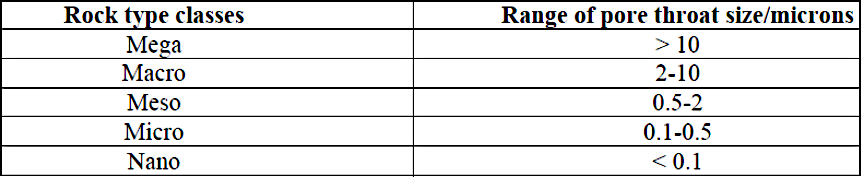
Classification of rock types according to pore throat radius
It is already known that relationships between lithology and NMR T2 distributions are present in terms of the shape (patterns) of the T2 distribution curves that correspond to particular litho-facies for some reservoirs. To build upon this knowledge, the NMR T2 distributions for the samples belonging to each rock type class were analyzed. We have found that pore throat radii obtained from the Pittman equations are functionality equivalent to the Timur-Coates equations, regarding the equivalence between the pore throat radius and the ratio Free Fluid Volume over Bound Fluid Volume (FFV/BFV), obtained using suitable T2 cut-offs.
Permeability Models
The parameters for the NMR permeability (KNMR) following the Timur-Coates equation were determined based on the best correlation for the cross-plot of KNMR vs. KKlinkenberg as shown in the next figure.
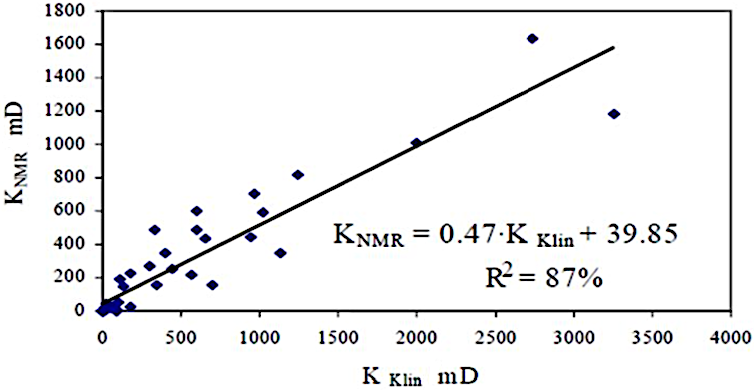
Cross-plot between NMR and Klinkenberg permeabilities: KNMR vs. KKlinkenberg
KNMR = 0.1 * φ3.05 * ( FFV / BFV ) 1.74
The Pittman equation that better fits the characteristic of the formation studied is:
r40 Pittman = 0.360 + 0.528 * log (K) - 0.680 * log (φ)
Using this equation and setting the radius of pore throat as a constant, several curves of permeability (K) as a function of the porosity (φ) can be plotted, defining the limits between the different rock types mentioned in the former table. In order to find the correspondence between the Pittman and the Timur-Coates equations, it is necessary to solve both in terms of permeability as follows:
log (K) = -0.680 + 1.288 * log (φ) - 1.894 * log (r40 Pittman)
and:
log (K) = 0.1 + 3.05 * log (φ) + 1.74 * log ( FFV / BFV )
Comparing the equations above, it follows that the logarithms of r40 and the ratio FFV/BFV are equivalent.
Results
Following this hypothesis, the T2 distributions of the core plug samples measured at both 100% water saturation and at irreducible water saturation (Swi) were analyzed in terms of the Free Fluid Volume (FFV) and Bound Fluid Volume (BFV). The results indicate that each rock type exhibits a distinct pattern in its T2 distribution and can be further characterized by its FFV/BFV ratio.
The figure below presents a permeability-porosity cross-plot with the delineated petro-facies and the representative T2 distribution curves for each rock type. These curves are consistent with the petrophysical classifications detailed in the table, which summarizes the corresponding parameters for each rock type, including pore throat radius, FFV/BFV ratio, and T2 cut-off. The results demonstrate strong agreement between the NMR-derived classification and the conventional petro-facies approach.
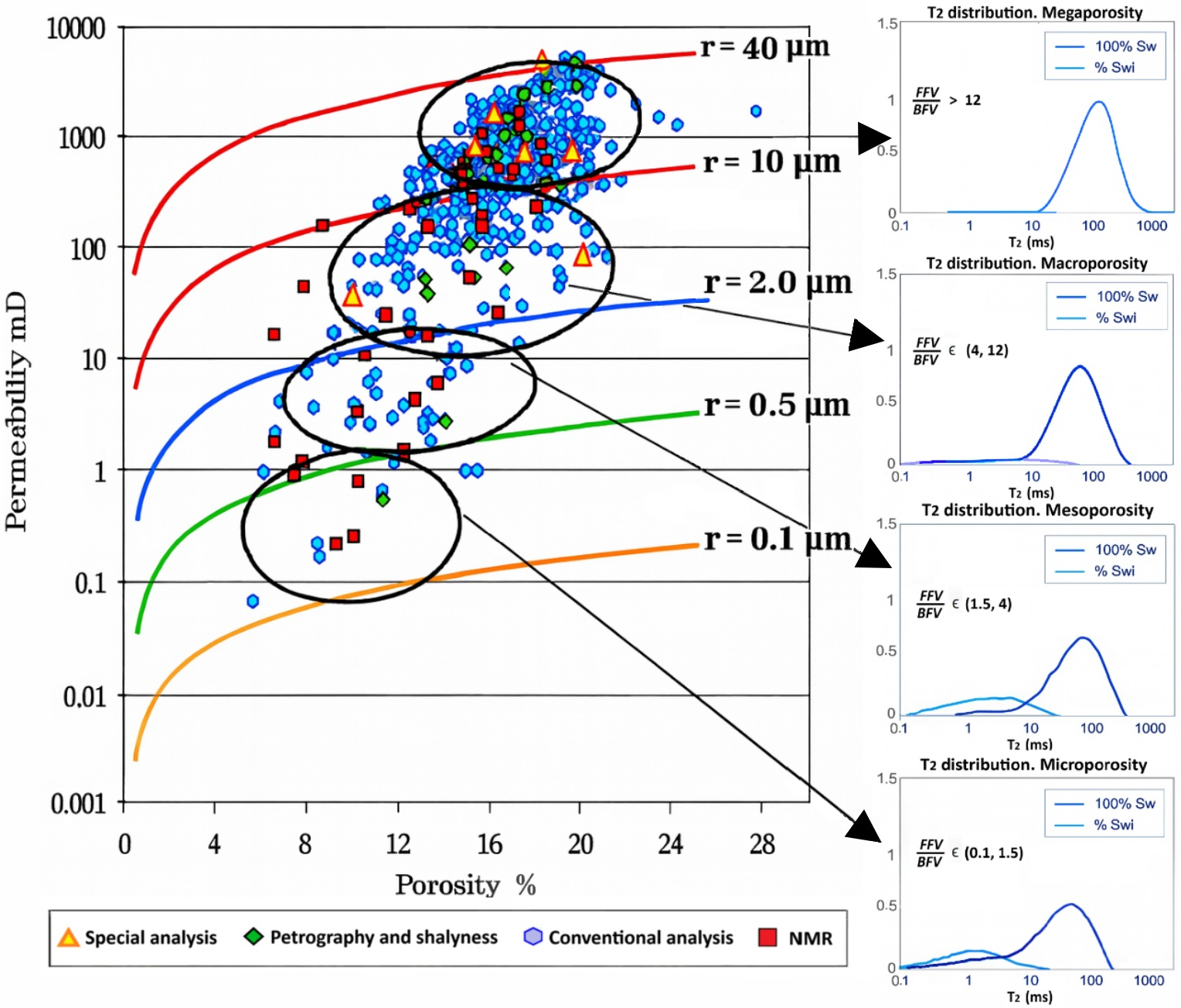
Permeability vs Porosity cross-plot with NMR T2 distributions
The advantage of a rock quality classification using NMR values lies in their direct determination, without going through the long way to find the pore throat radius dominating the fluid flow using the capillary pressure curves and Pittman equations. However, there is still a necessity of physical understanding of the correspondence between pore throat radius and the FFV/BFV ratio.
Conclusions
Low-field NMR technology provides an effective means of classifying rock quality. This study establishes a direct correlation between conventional rock typing which uses the dominant pore throat radius obtained from Pittman equations and the FFV/BFV ratio derived from NMR T2 distributions. These findings validate a streamlined, NMR-based classification system for rock quality. The method is not only applicable to laboratory core analysis but is also readily transferable to down-hole logging environments including those containing light hydrocarbons and wells drilled with water or oil based muds. To further refine this approach, future pore-scale investigations are needed to elucidate the physical relationship between pore throat radius and the FFV/BFV ratio.

|
Related articles:
|
 GeolOil is listed by the official
SPWLA software directory
GeolOil is listed by the official
SPWLA software directory
| |



|
|
|
© 2012-2026 GeolOil LLC. Please link or refer us under Creative Commons License CC-by-ND |