



 TRAINING


 PAPERS
 REFERENCES
 GET IN TOUCH

|

|
 Downloads
|
 Prices
|
 Videos
|


NMR (Nuclear Magnetic Resonance) Fluid Typing
By: Pedro Romero Rojas, GeolOil LLC. Published on January 2026 on the website geoloil.com
Summary
This article describes the principles of Nuclear Magnetic Resonance (NMR) fluid typing, focusing on 1D and 2D-NMR Laplace inversion transforms of the magnetization decay.
NMR logs provide valuable information about fluids within the invaded zone of the near wellbore volume, typically at depths of investigation between one to five inches. The range of detectable fluids depends on the magnetization decay being sampled at the inter-echo time (TE) under magnetic field gradients (G). Under these conditions, with nearly simultaneous field gradients, it is possible to calculate the diffusion constant a critical variable for fluid typing, particularly for distinguishing water and oil.
For gas detection, a powerful technique leverages the high diffusion constant of gas through the ratio R between T1 and T2app, where T2app is the T2 measured under magnetic field gradient conditions. The R ratio for gas can be up to two orders of magnitude higher than for oil or water. A higher GTE factor results in a higher R.
Introduction
One of the most common applications of NMR logging is lithology-independent porosity determination. Beyond this, NMR can discriminate porosity into clay-bound water, capillary-bound water, and movable fluid. This discrimination is based on cut-off values applied to the T2 distribution a one-dimensional representation of the NMR spectral response, as illustrated in Figure 1. Traditional NMR logging tools with a constant magnetic field (implying a single radio-frequency excitation of hydrogen nuclei) can achieve this goal.
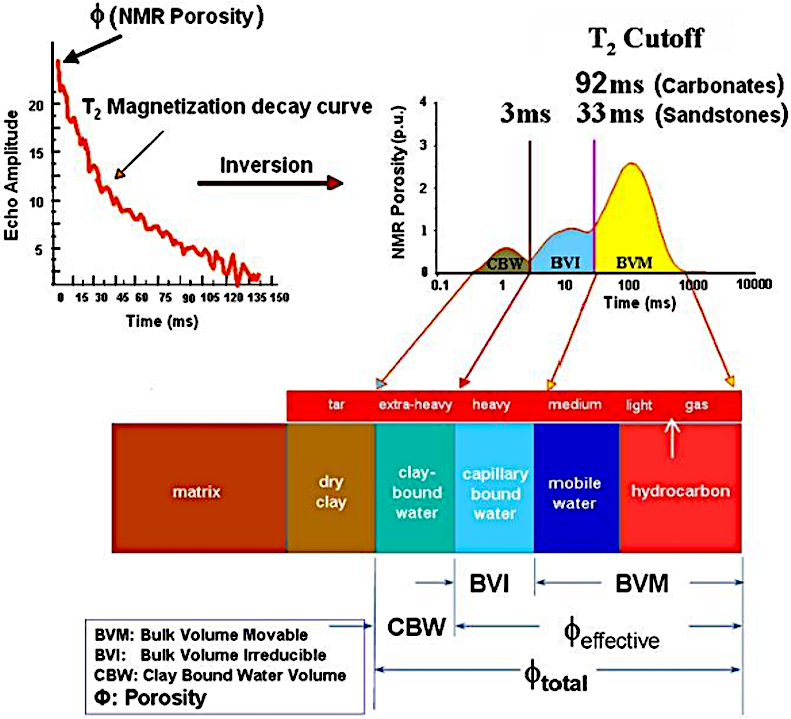
Figure 1. 1D-NMR porosity model: Cut-off partition of T2 spectrum
However, NMR data can yield more than porosity information. For instance, it is possible to identify the fluid type filling the pore space if logging is performed using a borehole tool capable of generating a static magnetic field with a gradient along its depth of investigation: a so-called NMR gradient tool. To utilize the gradient field while satisfying the resonance condition, the tool must operate at several radio frequencies corresponding to different investigation depths. Wireline NMR tools can generate up to six different radio frequencies (RF), covering a depth of investigation between one and five inches.
The necessity of a gradient tool for fluid typing stems from the nature of the NMR signal, which depends not only on the pore size distribution (for the wetting phase under fast-diffusion limits) and fluid viscosity (for the non-wetting phase) but also on the coupling between the fluid's diffusion constant and tool parameters such as G and TE. Appropriate post-processing software identifies water and hydrocarbons and computes corresponding fluid saturations by combining acquired data to maximize fluid contrast. Consequently, T distributions for hydrocarbons and water can be generated using forward modeling.
1D-NMR refers to the basic GTE left-shift of T spectra and the forward modeling of hydrocarbon and water inversions. 2D-NMR involves Diffusion-T2 and T1 - T2 maps.
The gradient strength of an NMR tool decreases with frequency. This gradient feature enables the excitation of multiple sensitive volumes in a single polarization time using a frequency-interleaving method. The operating frequency band ranges from approximately 400 kHz to nearly 1 MHz, with sufficient separation to avoid interference between neighboring sensitive volumes. Because the tool's field gradient magnitude varies with frequency, echo trains acquired at different frequencies can exhibit different apparent decay rates, even with identical acquisition parameters (TE and wait time TW).
The tool's multi-frequency capability allows for the acquisition of a large number of echo trains in a single pass, providing both formation and fluid properties. Data acquisition can be optimized for expected formation fluids (e.g., heavy oil, light oil, or gas). Porosity and permeability are also calculated in all acquisition modes.
All acquired echo trains satisfy the following equation:
Conclusions

|
Related articles:
|
 GeolOil is listed by the official
SPWLA software directory
GeolOil is listed by the official
SPWLA software directory
| |



|
|
|
© 2012-2026 GeolOil LLC. Please link or refer us under Creative Commons License CC-by-ND |